
Retail growth is not just about the number of stores anymore, but how these fit into the overall portfolio.
As physical retail expands across the Gulf and consumer journeys increasingly span digital and physical channels, the value of a location depends on the role it plays in the wider commercial network.
TAIB Advisory · July 2026 · 8 min read
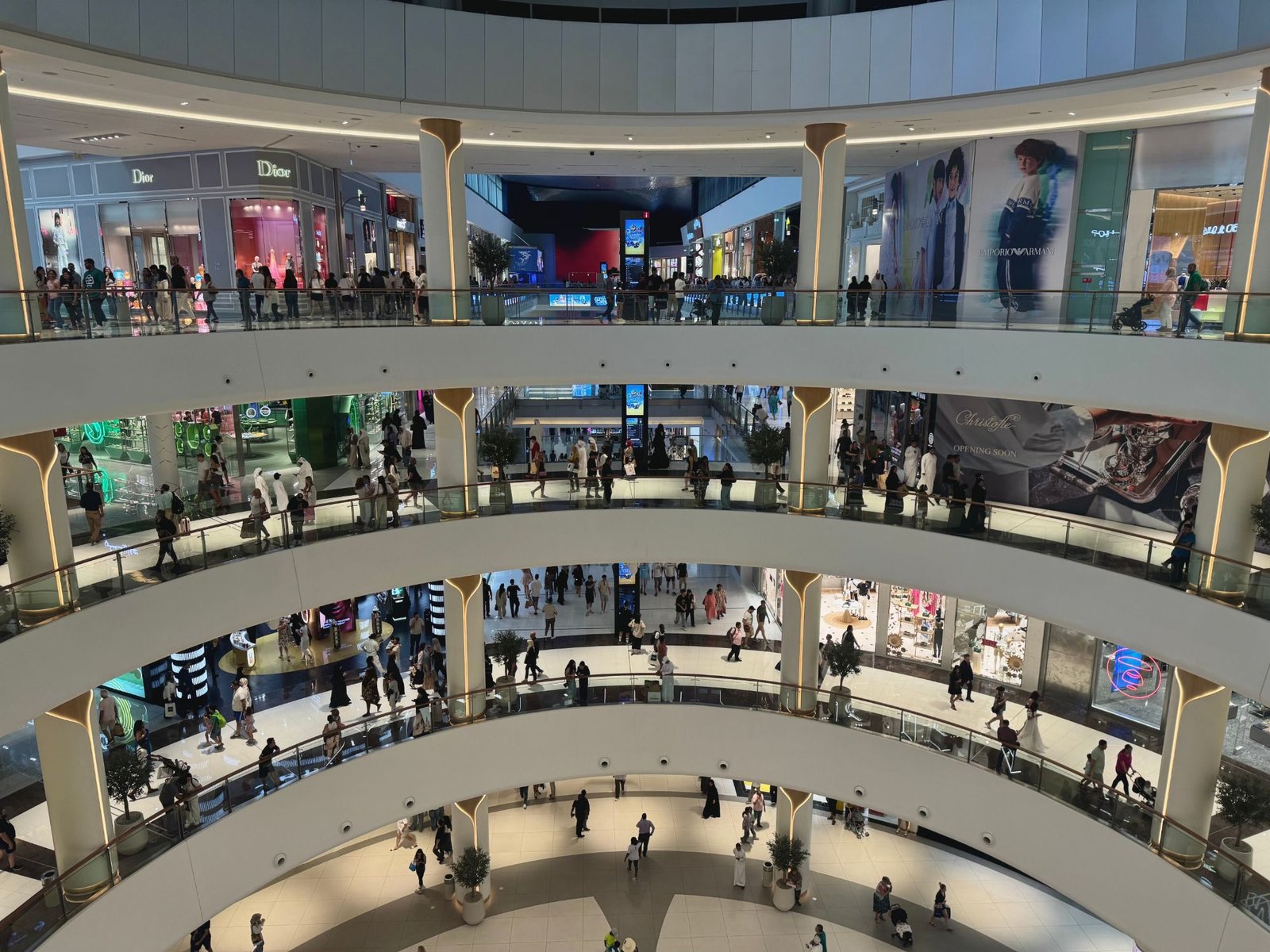
The Gulf is not running out of retail ambition. Across the region, new destinations, mixed-use developments and premium retail concepts continue to attract substantial investment. Saudi Arabia alone is planning more than 1.3 million square meters of lifestyle retail space across Riyadh and Jeddah by 2027, according to Knight Frank reporting published in June. The developments are being designed around a broader mix of retail, dining, entertainment and social activity rather than shopping alone.1
At the same time, the customer journey is becoming less dependent on the physical store. In the UAE, 85% of consumers surveyed by Visa in early 2026 said they had used AI to assist with shopping, 60% said they use it to check reviews or product ratings, 59% to compare prices, and 60% said they discover new brands or retailers while shopping online. Sixty-nine percent reported having purchased directly through social media.2
Those two developments are not contradictory. They are the reason the next question for retailers is less about whether physical retail matters and more about what each physical location is there to accomplish.
The store is no longer the whole journey
BCG’s May research on Middle Eastern retail describes a market in which e-commerce, omnichannel ecosystems, experience-led consumption, retail media and AI-driven discovery are changing the economics of physical space. It estimates that up to 25% of revenue at leading retail assets can already come from sources beyond conventional gross leasable area, and it identifies different models emerging around convenience, experience and broader ecosystem value.3
That is an important shift in perspective. A store used to be evaluated primarily as a place where a customer arrived, browsed and bought. Increasingly, the customer’s relationship with the brand can begin somewhere else: in a social feed, through an online search, inside an AI-assisted comparison, through a marketplace, or because another customer shared an experience. The physical location may then play a very different role, such as helping the customer understand the product, experience the brand, receive advice, collect an order or resolve a problem.
BCG’s May customer-experience research makes a similar point from the consumer side. Shopping journeys now move across digital and physical environments, while brands are still judged by the quality and continuity of the overall experience even when they no longer control every touchpoint.4
For retailers, that means the old distinction between “online” and “offline” is becoming less useful. The customer sees one relationship. Management needs to design one commercial system.
A new store does not automatically create new value
This becomes particularly relevant as the Gulf adds more physical retail capacity. More space can create more opportunities, but it can also make the network harder to manage. A new location can attract new customers, strengthen brand visibility or unlock an underserved catchment. It can also duplicate an existing catchment, spread inventory across too many points, increase fixed costs or compete for the same customers as another location.
The strategic question is therefore not simply whether a proposed store has enough expected sales. It is what job the location is supposed to perform within the broader commercial network, and whether the investment required is appropriate to that job.
Consider the different roles a physical location can play. A neighborhood store may be primarily about convenience and frequency. A flagship may be designed to build brand equity and attract customers who would not otherwise engage with the brand. A specialist location may be about consultation and service. Another site may exist partly because its inventory position makes same-day fulfillment or click-and-collect more economical. A destination within a major mall may be expected to create traffic and engagement well beyond the transactions recorded at the till.
None of these roles is inherently better than another. The problem arises when they are all managed as if they were the same.
The Gulf is already showing what this looks like in practice
Saudi Arabia provides a useful illustration of the direction of travel. Reporting in June on Knight Frank’s market outlook described more than 1.3 million square meters of lifestyle retail space planned across Riyadh and Jeddah, with developments increasingly combining shopping with dining, entertainment and social experiences. The implication for brands is that a retail location can become part of a destination proposition rather than simply a place to transact.1
Dubai offers another useful example from the other side of the equation. In May, WWD reported that Majid Al Futtaim was closing THAT Concept Store at Mall of the Emirates and redeploying its footprint as part of the mall’s wider repositioning; the company described the move as a strategic reset and said the space would support an elevated luxury footprint and new experience-led concepts.5
There is no basis in the reporting to conclude that the closure itself proves the original concept failed. What it does show is that valuable physical space can be reassigned when the role of a destination changes. The relevant management question is not “Was the store good or bad?” but “What is the highest-value use of this space within the next version of the network?”
The same principle applies at the brand level. A May report on Dubai-based eyewear and lifestyle brand Karen Wazen described its opening of a flagship at Dubai Mall as part of a broader multistore rollout and category expansion. The location was explicitly framed as an international statement because of the mall’s target customer and footfall.6 A flagship in that context is not simply another point of distribution; its value can include brand positioning, customer acquisition and the ability to project a regional brand into an international destination.
Physical retail can also create value by connecting smaller brands into a larger ecosystem. In June, Majid Al Futtaim said its Ma’an programme had supported close to 70 Dubai-based homegrown brands, with participating businesses gaining access to retail environments, pop-ups, entertainment platforms and the group’s SHARE loyalty programme. Twelve brands had been onboarded onto SHARE, extending their reach beyond the physical mall.7
The lesson is broader than any one company. A physical destination can function as a distribution channel, an acquisition platform, a brand-building environment and an access point into a larger customer ecosystem. The commercial value lies in how those functions work together.
The new question is the role of the location
That leads to a simple but important change in how store networks should be designed. Instead of starting with “Where should we open?”, management should first define “What do we need this location to do?”
The answer might be transaction, acquisition, brand experience, relationship or network support. Those roles overlap, but they should not be confused. A premium flagship can justify high investment because the brand effect is part of the proposition. A convenience location should be judged more heavily on frequency, accessibility and operating efficiency. A location that supports fulfillment needs to create enough network benefit to justify the space and inventory it consumes.
Once the role is clear, the economics become easier to evaluate. The right KPIs are no longer identical across the estate. Sales per square meter may remain important, but it may need to sit alongside customer acquisition, repeat behavior, service conversion, fulfillment economics, inventory productivity, digital engagement or other measures that reflect the purpose of the site.
This is where retail strategy becomes a portfolio question rather than a property question. One location can have strong standalone economics and still be the wrong use of capital if a nearby store already serves the same demand. Another can have modest direct sales and still deserve investment because it creates disproportionate brand, customer or network value. The answer depends on the role, the alternatives and the economics of the system as a whole.
AI will make this more important, not less
The rise of AI in shopping adds another layer. The UAE data is already showing that consumers are using AI to compare prices, check reviews and discover brands, even though most are not yet comfortable handing an AI agent the final checkout decision.2 Visa also found that nearly 60% of UAE businesses were interested in or actively exploring agentic-commerce use cases in a May 2026 programme launch.8
That does not make the physical store obsolete. It makes the store’s role more specific. When discovery and comparison are increasingly mediated by digital interfaces, a physical location has to give the customer a reason to value being there. That reason might be expertise, physical trial, service, immediacy, exclusivity, community or an experience that is difficult to reproduce online.
For management, the bigger opportunity is not simply to add more technology to stores. It is to use better data to understand how physical and digital behavior interact, then allocate space and investment accordingly. A store that drives online conversion should not be evaluated in exactly the same way as one whose purpose is purely transactional. A location that protects customer relationships in a difficult category may be strategically more valuable than its immediate sales suggest. The point is not to make the measurement more complicated for its own sake; it is to make the economics reflect the way customers actually behave.
The discipline is in making the trade-offs
There is an understandable temptation, especially in high-growth retail markets, to try to do everything at once: add stores, create experiences, strengthen digital, expand loyalty, increase entertainment, widen the assortment and capture more data. But a larger proposition is not necessarily a better one.
BCG’s Middle East research makes the broader point that leading retail assets are making explicit choices about where to concentrate investment and organizational capability rather than trying to lead on every dimension simultaneously.3 For brands, the same principle applies at the store-network level.
A retailer deciding where to invest the next dollar should be able to answer a few straightforward questions. What customer problem is this location solving? What role does it play that another location cannot? What value does it create beyond the transaction made inside the store? What would be lost if it were smaller, moved, closed or replaced by another format? And what should success look like given the role we have assigned to it?
Those questions are deliberately commercial. They force management to connect footprint decisions to customer strategy, route-to-market, capital allocation and profitability rather than treating real estate, brand, digital and operations as separate discussions.
The Gulf does not need less physical retail. It needs more purposeful physical retail
The current Gulf retail build-out is not evidence that physical stores are becoming irrelevant. It is evidence that the role of physical retail is being renegotiated while the amount of space continues to grow. That is a much more interesting strategic situation.
The strongest retailers will not necessarily be the ones with the largest store networks or the most elaborate destinations. They will be the ones that know what each part of the network is supposed to achieve, understand the economics of that role and have the discipline to allocate capital accordingly.
As consumer journeys become more fragmented across stores, social platforms, marketplaces and AI-assisted discovery, the unit of retail strategy is shifting. It is no longer simply the store. It is the relationship between the customer, the location, the channel and the wider network.
That is the opportunity in the Gulf: not simply to build more retail, but to make every part of the retail portfolio commercially purposeful.
Sources
- Communicate Online — “The 1.3 million sqm retail bet that could redefine shopping in Saudi Arabia” (5 June 2026) — reporting on Knight Frank’s market outlook: planned lifestyle retail space in Riyadh and Jeddah, and the shift toward mixed retail, dining, entertainment and social destinations. communicateonline.me (opens in a new tab)
- Visa — “Visa Study: 85% in UAE Use AI to Shop, But Trust is Key at Checkout” (9 June 2026) — UAE consumer survey on AI-assisted shopping, online discovery, social commerce and trust in AI checkout. visa.com (opens in a new tab)
- Boston Consulting Group — “Imagining the Future of Retail: Beyond Space” (6 May 2026) — Middle East retail dynamics, non-GLA revenue, the changing economics of physical retail and emerging retail models. bcg.com (opens in a new tab)
- Boston Consulting Group — “The New Rules of Customer Experience in the Age of Agents” (7 May 2026) — evidence on customer journeys spanning digital and physical touchpoints, and the changing role of the store. bcg.com (opens in a new tab)
- WWD — “Majid Al Futtaim to Close THAT Concept Store in Dubai’s Mall of the Emirates” (21 May 2026) — reported closure and footprint redeployment as part of the mall’s repositioning, described by the company as a strategic reset. finance.yahoo.com (opens in a new tab)
- WWD — “Karen Wazen Opens Flagship at Dubai Mall” (21 May 2026) — flagship opening as part of a wider brand rollout and international growth plan. finance.yahoo.com (opens in a new tab)
- Majid Al Futtaim — “Majid Al Futtaim and Dubai SME expand Ma’an to showcase homegrown SMEs at Mall of the Emirates” (18 June 2026) — retail and loyalty ecosystem access for Dubai-based SMEs and homegrown brands. majidalfuttaim.com (opens in a new tab)
- Visa — “Visa Launches Agentic Ready Program in UAE to Accelerate Agent-Led Commerce” (20 May 2026) — nearly 60% of UAE businesses expressing interest in or actively exploring agentic-commerce use cases. visa.com (opens in a new tab)
This note uses only evidence published through June 2026. The portfolio and store-role framework is TAIB’s analytical synthesis of the cited research and examples; it is not a restatement of any single source.