
Smart mobility is proving the technology. Can it prove the business model?
Abu Dhabi is showing what commercial autonomous mobility can look like. The harder question is whether the economics can scale.
TAIB Advisory · August 2026 · 6 min read
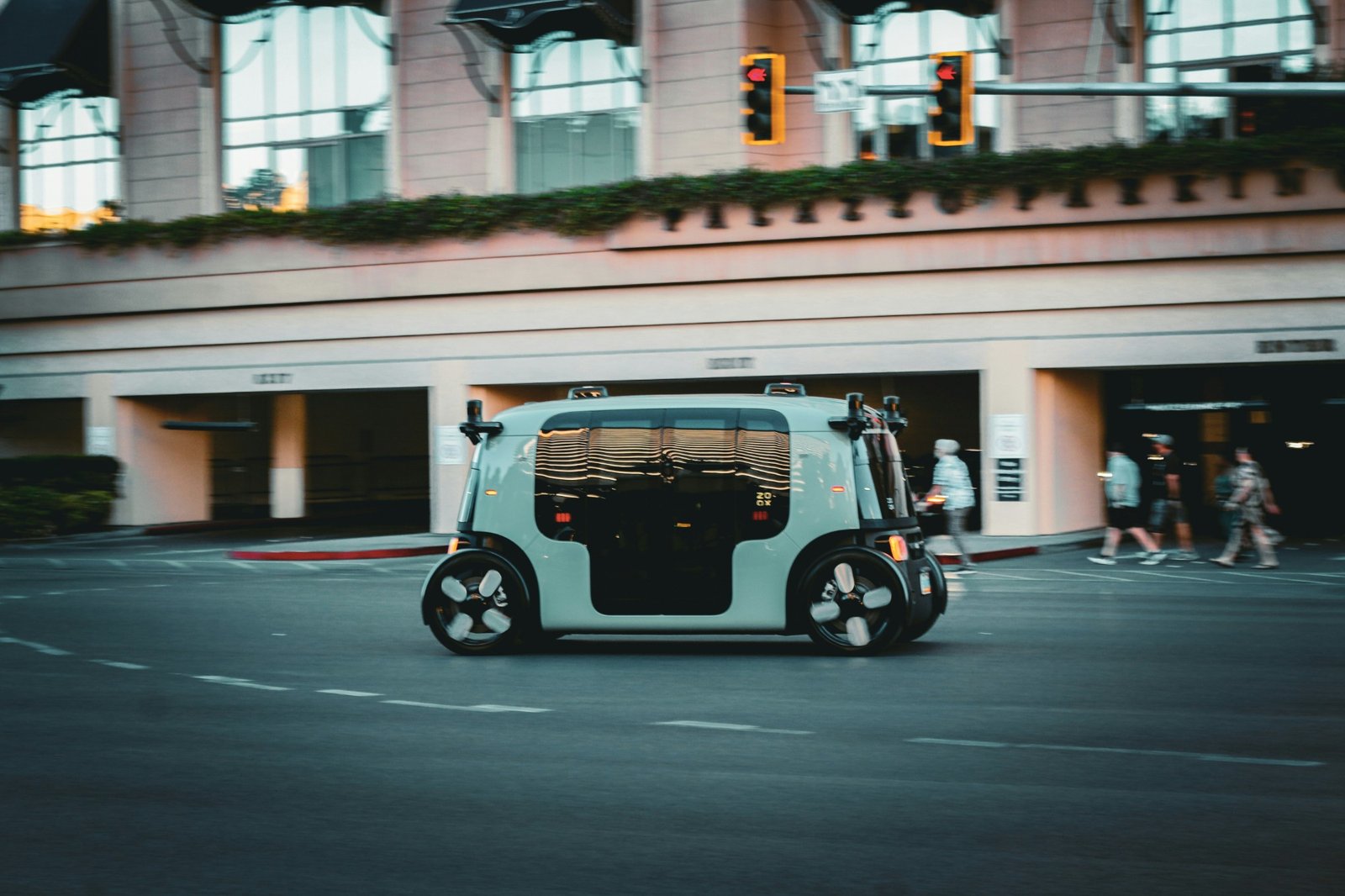
Smart mobility is no longer waiting for the technology to arrive. In Abu Dhabi, parts of the autonomous-mobility ecosystem have already moved into commercial operation. The more difficult question is what happens next: can the technology translate into a business model that works repeatedly, economically and at scale?
In November 2025, the emirate began commercial operations of fully driverless Level 4 autonomous vehicles. Abu Dhabi Mobility now reports 69 autonomous vehicles operating in its commercial fleet, more than 91,000 autonomous trips, more than 900,000 kilometres covered and more than 40,000 users served.12
That is an important transition, because once autonomous vehicles are carrying passengers in commercial service, the question changes. It is no longer simply whether the technology works. It becomes whether the business can work repeatedly, at scale, and with economics that improve rather than deteriorate as the operation grows.
Abu Dhabi is building more than a driverless taxi service
What is particularly interesting about Abu Dhabi is that the autonomous-vehicle rollout is being built as an ecosystem rather than as a standalone vehicle programme. Abu Dhabi Mobility operates AViTOMS, a central digital platform that manages applications, approvals and live deployment oversight for autonomous vehicles, while operators including WeRide and K2 are already registered on the system.2
At the broader industry level, Abu Dhabi’s Smart and Autonomous Vehicle Industries cluster, SAVI, is designed to support smart mobility across land, air and sea, alongside technologies such as lidar and sensor fusion, V2X communications, batteries, AI-enabled predictive maintenance and 5G connectivity. The government says the cluster is expected to contribute AED 90–120 billion to the UAE economy and generate 30,000–50,000 jobs; those are projections, not realized outcomes.3
That distinction matters. Autonomous mobility is not just a vehicle problem. Around the vehicle sit regulation, infrastructure, fleet operations, maintenance, energy, software, data, customer acquisition, payments, insurance and access to demand. A technology can therefore be ready before the commercial system around it is.
The difficult part starts after the technology works
This is where smart-mobility business cases become more interesting. An autonomous vehicle changes the cost structure of a mobility service, but it does not remove the need for economics.
A 2024 study of robotaxi operating models found that labor remains a significant operational cost in existing robotaxi services, even though the modeled operating costs were lower than those of traditional taxis. More importantly, the researchers identified utilization rates and annual mileage as key factors determining robotaxi competitiveness.4
In other words, removing the driver does not automatically create a good business. The vehicle still has to be productive. It needs to generate enough paid activity, at an appropriate price, for enough of its available operating time to support the cost of the vehicle, technology and surrounding operation.
This makes utilization one of the central commercial questions in autonomous mobility.
A fleet does not become attractive simply because it is autonomous
Consider two autonomous vehicles with identical technical capabilities. One operates in a dense area with predictable demand, strong infrastructure and good integration into a booking platform. The other operates across a wider geography with fragmented demand and more repositioning between trips. The technology may be identical; the economics will not be.
Research on autonomous ride-hailing points in the same direction. A 2026 Management Science study comparing platform-based ride-hailing with vertically integrated autonomous services found that, in larger markets with sufficiently patient customers, the platform model can retain advantages in market share and profitability even when the autonomous model has a cost advantage. The result depends on market size, customer behavior, capacity and platform structure.5
That is a useful reminder that the vehicle is not the business model. The commercial advantage may sit in the customer relationship, the distribution channel, fleet utilization, the platform, the partner ecosystem, or the combination of them.
Abu Dhabi is a useful example of why the distinction matters
The progress in Abu Dhabi is real, but the public data does not allow an outsider to conclude that autonomous mobility there has already reached sustainable unit economics. We know the fleet size, trips, kilometres and users. We know the regulatory and digital infrastructure is being built around commercial deployment. We know Abu Dhabi is investing in a broader smart-mobility ecosystem.123
What we do not have from those public figures is enough information to calculate profitability: fare revenue per trip, revenue per vehicle-hour, utilization by vehicle, full operating costs, infrastructure costs or contribution margin.
So I would resist using the rollout as proof that the business model has already been proven. It demonstrates something more useful: the technology and operating ecosystem have progressed far enough for the commercial model to be tested in the real world.
That is the point at which the questions become more interesting.
Where is the economics attractive first?
Not every geography, route or customer segment will have the same economics. The first commercially attractive market may be a specific operating zone rather than an entire city. Market selection therefore becomes part of the business model, not simply a market-entry exercise.
Can utilization improve faster than cost?
A vehicle that spends more time carrying paying passengers and less time waiting, repositioning or being maintained is economically different from one that does not. The question is not simply how many vehicles can be deployed, but how much productive activity each additional vehicle creates.
Who owns the customer?
A smart-mobility company can own excellent technology and still struggle commercially if another platform controls customer access. The 2026 research is particularly relevant here: platform structure can materially affect market share, pricing and profitability in competition between ride-hailing and autonomous services.5
What has to be true for the model to scale?
Early deployments can work under unusually supportive conditions: selected routes, controlled service areas, partner support, regulatory attention or a concentrated demand pool. A durable business is different. The question becomes whether the economics survive when the company moves beyond the first attractive corridor or customer group.
The broader smart-mobility challenge
Autonomous vehicles make the issue particularly visible because the technology is so obvious. But the principle extends well beyond autonomy. Across smart mobility, companies can be built around an impressive technical proposition — better sensors, better batteries, better software, better connectivity — while the harder commercial questions remain unresolved.
Who will pay? How often? At what price? Through which channel? With what infrastructure? And what happens to the economics when the business moves from ten vehicles to a thousand?
Those questions are not secondary to the technology. They are part of the product.
The real milestone is repeatability
A successful autonomous trip is evidence that the technology can work. A growing fleet is evidence that deployment is possible. High customer satisfaction is evidence that users may accept the service. Dubai’s RTA, for example, reported more than four million kilometres traveled by its Robotaxi programme, 7,613 passenger trips, 144 vehicles in the fleet and 48 vehicles in active operation in August 2026, alongside a reported 97% customer satisfaction rate.6
None of those measures, on their own, establishes a sustainable business model.
The harder milestone is repeatability: when the next vehicle can be added without disproportionately increasing complexity, when demand supports productive utilization, when partners strengthen rather than dilute the proposition, and when the business becomes economically stronger as it scales.
That is when smart-mobility technology stops being just an impressive technology and starts becoming a business.
For companies entering this space, I would therefore start with a different question. Not simply, “Can we build it?” but: “Where, for whom and under what operating model does it become a better business?”
Sources
- Abu Dhabi Mobility — Autonomous Mobility: current AV operations, AViTOMS, 69 vehicles, 91,075+ trips, 900,000+ km, 40,000+ users. admobility.gov.ae (opens in a new tab)
- Abu Dhabi Mobility — 13 November 2025: commencement of commercial operations for fully driverless Level 4 autonomous vehicles. admobility.gov.ae (opens in a new tab)
- Abu Dhabi Department of Economic Development — SAVI cluster: scope, technologies and stated AED 90–120bn / 30,000–50,000 jobs projections. added.gov.ae (opens in a new tab)
- Kaplan, Nurullaeva & Helveston, Transport Policy (2024) — “Modeling the operational and labor costs of autonomous robotaxi services.” doi.org (opens in a new tab)
- Noh, Tunca & Xu, Management Science (published online 30 April 2026) — “Evolution of Ride Services: From Ride Hailing to Autonomous Vehicles.” doi.org (opens in a new tab)
- Dubai Roads & Transport Authority — 19 August 2026: Robotaxi operating data and customer satisfaction. www.rta.ae (opens in a new tab)