
Formula 1 is no longer a sponsorship. It’s a commercial platform.
The most valuable partnerships are increasingly built around what happens beyond the logo — from content and hospitality to customer engagement, market entry and new commercial models.
TAIB Advisory · September 2026 · 6 min read
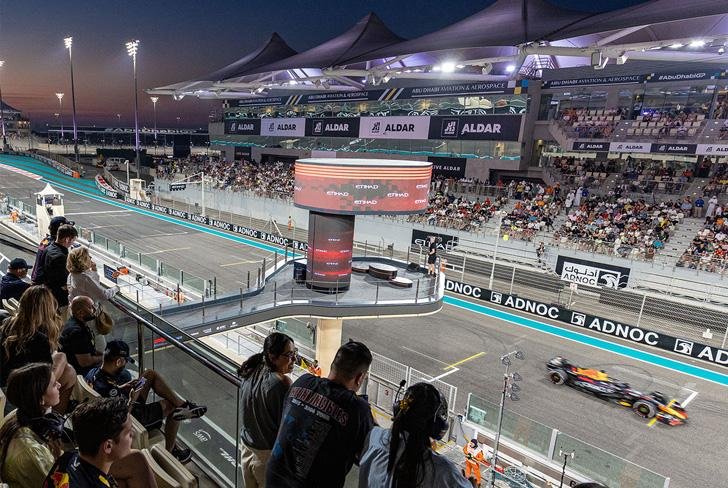
Formula 1 has become a much larger commercial proposition than the sponsorship model that traditionally surrounded it. The sport generated $3.9 billion of revenue in 2025, with its primary revenue built around three core rights streams — race promotion, media rights and sponsorship — while a growing layer of hospitality, digital products, licensing and other experiences sits around them. The shift matters for brands because it changes what a partnership can actually do: the logo is still there, but increasingly it is only the visible part of a much larger commercial relationship.1
The same direction is visible in the way Formula 1 is building its partner portfolio. By the end of 2025, F1 said the number of partners had increased from 12 in 2020 to 31, spanning sectors from food and drink to fashion and luxury, technology, transport and entertainment. In the first half of 2026 alone, F1 added further partners including Standard Chartered, Marsh, FanDuel, Betway, Flexjet and Fever.23
That growth is interesting in its own right, but the more useful question for a company considering an F1 partnership is not how many people the sport reaches. It is what the company can build around that reach.
The rights are becoming the starting point, not the finished product
The clearest examples are the recent partnerships that extend well beyond trackside visibility. PepsiCo’s agreement with Formula 1 runs to 2030 and brings three of its brands — Sting Energy, Gatorade and Doritos — into the sport through Fan Zone activations, digital experiences, content, on-pack promotions and co-branded products, alongside traditional trackside and hospitality rights.4
LVMH has taken the idea further in a different direction. Its ten-year global partnership involves Louis Vuitton, TAG Heuer and Moët Hennessy, with the relationship built around hospitality, bespoke activations, limited editions, content and a series of roles embedded directly into the sport. The commercial logic is not simply to place a luxury logo next to Formula 1; it is to make the association between the two brands tangible in products, experiences and the way guests encounter the sport.5
Even the hospitality proposition is being treated as a product in its own right. Formula 1’s F1 Garage, developed with Gordon Ramsay, combines direct exposure to the paddock and pit lane with premium food and service, while DO & CO’s ten-year extension as the Paddock Club supplier underlines the scale and sophistication of the hospitality business. Formula 1 said Paddock Club had welcomed more than 150,000 guests during the 2024 season.67
And in 2026, Fever became an Official Supplier with a five-year agreement to provide a new ticketing platform on F1.com covering general admission, local hospitality and Paddock Club tickets. That may sound operational rather than commercial, but it is really the same story: the sport is working on the entire customer journey, not just the two hours of racing.8
The commercial opportunity is therefore broader than sponsorship
Formula 1’s own economics make this quite clear. In 2025, 31% of F1 revenue came from media rights and 26.7% from race promotion, while sponsorship formed another major part of the commercial model. Liberty Media’s reporting also describes F1 as generating revenue through the commercial exploitation of the championship, rather than through sponsorship alone.1
Around those core rights, Formula 1 has built an increasingly broad set of ways to monetize the relationship with its audience: hospitality, licensing, digital products, content, events, ticketing and consumer experiences. In the first half of 2026 alone, F1 signed 20 new consumer-products licensing partners, including collaborations involving Disney, LEGO, Topps, Hasbro and Hot Wheels.3
This matters because it changes the question a prospective partner should ask. “How much visibility do we get?” is a reasonable starting question, but it is not a strategy. A better one is: what commercial objective are we trying to achieve, and which combination of rights, experiences, content, customers and markets can actually help us achieve it?
The strongest partnerships connect to a real business objective
A financial institution, for example, may care less about mass awareness than about getting in front of business owners, investors and senior decision-makers. Standard Chartered’s 2026 partnership is explicitly positioned around wealth management and corporate and investment banking, and includes trackside activations designed to connect the bank with its clients and guests.9
A technology company may want credibility around innovation rather than a conventional brand campaign. A consumer company may want retail activation and new customer acquisition. A luxury business may care about hospitality, cultural relevance and access to a high-value audience. A company entering a new market may value the network around a Grand Prix weekend — customers, partners, media and government stakeholders — as much as the broadcast exposure itself.
Those are very different commercial objectives, even when the sponsorship inventory looks similar on a rate card. The value of the partnership therefore depends on what happens after the rights have been bought: how well the assets fit the company’s strategy, how effectively they are activated, whether the organization can convert attention into relationships, and whether the partnership becomes more valuable over time rather than being rebuilt from scratch every season.
F1 increasingly behaves like an ecosystem
The sport’s growth in audience and digital reach makes that ecosystem more valuable. Formula 1 reported more than 830 million fans globally by the middle of 2026, more than 126 million social followers and 3.7 million attendees across the first 11 race weekends of the season. It also reported 20 new licensing partners in the first half of the year and more than 60,000 guests across its hospitality spaces.3
Those numbers should not be mistaken for a measure of sponsorship return; they are indicators of the scale and range of the platform. The important point is that the audience is no longer confined to the race weekend. F1 is reaching people through broadcast, social platforms, content, licensing, live experiences and increasingly sophisticated digital channels.3
That creates more room for commercial creativity, but it also raises the bar for partnership strategy. When there are more ways to engage an audience, simply buying more inventory does not necessarily create more value. It becomes more important to decide which audience matters, what behavior or relationship the company wants to change, and which assets give it a credible way to do that.
The Gulf makes this particularly interesting
For companies operating in the Middle East, the opportunity is even broader because Formula 1 is no longer an occasional regional spectacle. The championship’s calendar includes races in Bahrain, Saudi Arabia and Abu Dhabi, while F1’s commercial partners increasingly use the sport as an international platform rather than a local sponsorship property. The 2026 partnership with Standard Chartered, for example, explicitly links the bank’s international footprint to F1’s global reach, while Flexjet’s partnership is built around the operational reality of moving people across a 24-race calendar in 21 countries.910
For a Gulf-based company, that creates an interesting strategic proposition. A Grand Prix can be a sponsorship platform, but it can also be a place to convene customers, strengthen institutional relationships, launch a product, enter a market, entertain strategic partners or give a regional brand a global stage. The commercial value comes from designing those pieces to work together.
The question is not whether to sponsor F1
There will always be companies for whom a straightforward awareness play makes sense, and sponsorship will remain one of Formula 1’s core commercial revenue streams. But for a business that wants more from the relationship, the real opportunity lies in treating F1 as a platform rather than a media placement.
That means starting with the business objective, not the rights package: identifying the customers or stakeholders that matter, choosing the markets and moments where the sport gives the company something distinctive, and then building the content, hospitality, partnerships, product activity and customer experience around that objective.
The most valuable F1 partnerships are therefore unlikely to be the ones with the biggest logo. They will be the ones where the partnership becomes part of how the business grows — a route to customers, relationships, markets and experiences that the company could not have built as effectively on its own.
Sources
- Liberty Media / U.S. SEC — Liberty Media 2025 Form 10-K — 2025 F1 revenue, revenue mix and commercial rights model. sec.gov (opens in a new tab)
- Formula 1 — 2025 Season Review — partner portfolio and audience / commercial development. corp.formula1.com (opens in a new tab)
- Formula 1 — 2026 Season Half-Year Review — fan, attendance, social, hospitality, licensing and partnership figures. corp.formula1.com (opens in a new tab)
- Formula 1 — PepsiCo announced as Official Partner — partnership scope: Fan Zones, content, digital, promotions, products, hospitality. formula1.com (opens in a new tab)
- LVMH — LVMH x Formula 1 — ten-year partnership and activation model across LVMH Maisons. lvmh.com (opens in a new tab)
- Formula 1 — F1 Garage with Gordon Ramsay — premium hospitality proposition. corp.formula1.com (opens in a new tab)
- Formula 1 — DO & CO as Paddock Club supplier — ten-year extension and 2024 guest number. formula1.com (opens in a new tab)
- Formula 1 — Fever as Official Supplier — 2026 ticketing and customer-journey partnership. corp.formula1.com (opens in a new tab)
- Formula 1 — Standard Chartered partnership — 2026 wealth management / CIB partnership and client activation. corp.formula1.com (opens in a new tab)
- Formula 1 — Flexjet as Official Private Aviation Supplier — 24 races across 21 countries. corp.formula1.com (opens in a new tab)
F1 and Liberty Media figures are company-reported unless otherwise stated. They are used here to show the scale and breadth of the commercial platform, and should not be read as independent measurements of sponsorship return or causality.